How NexRex remembers you
What Rex keeps, what it forgets, and how that memory helps your coach — or you running solo
Good coaching is a relationship, and relationships run on memory. A great coach remembers that you only run in the mornings, that your left knee gets cranky in the cold, that the last time you pushed through a niggle it cost you two weeks. They remember what they tried with you, why, and how it turned out.
The catch is that coaches are human. Looking after a group of runners, nobody can hold every detail of every athlete in their head across months. Things slip. Context gets re-established from scratch. The runner re-explains the knee thing for the fourth time.
That's the gap Rex fills. Rex is not your coach — it's the AI assistant that sits alongside your coach and remembers, so coaching stays personal even at the scale of a whole group. And if you run on your own, Rex is still useful: a companion that remembers you between sessions when there's no coach in the loop.
This post is about how that memory works: what Rex keeps, what it refuses to keep, and how it becomes a daily insight, a weekly summary, and a conversation that doesn't start over every time.
Three kinds of memory
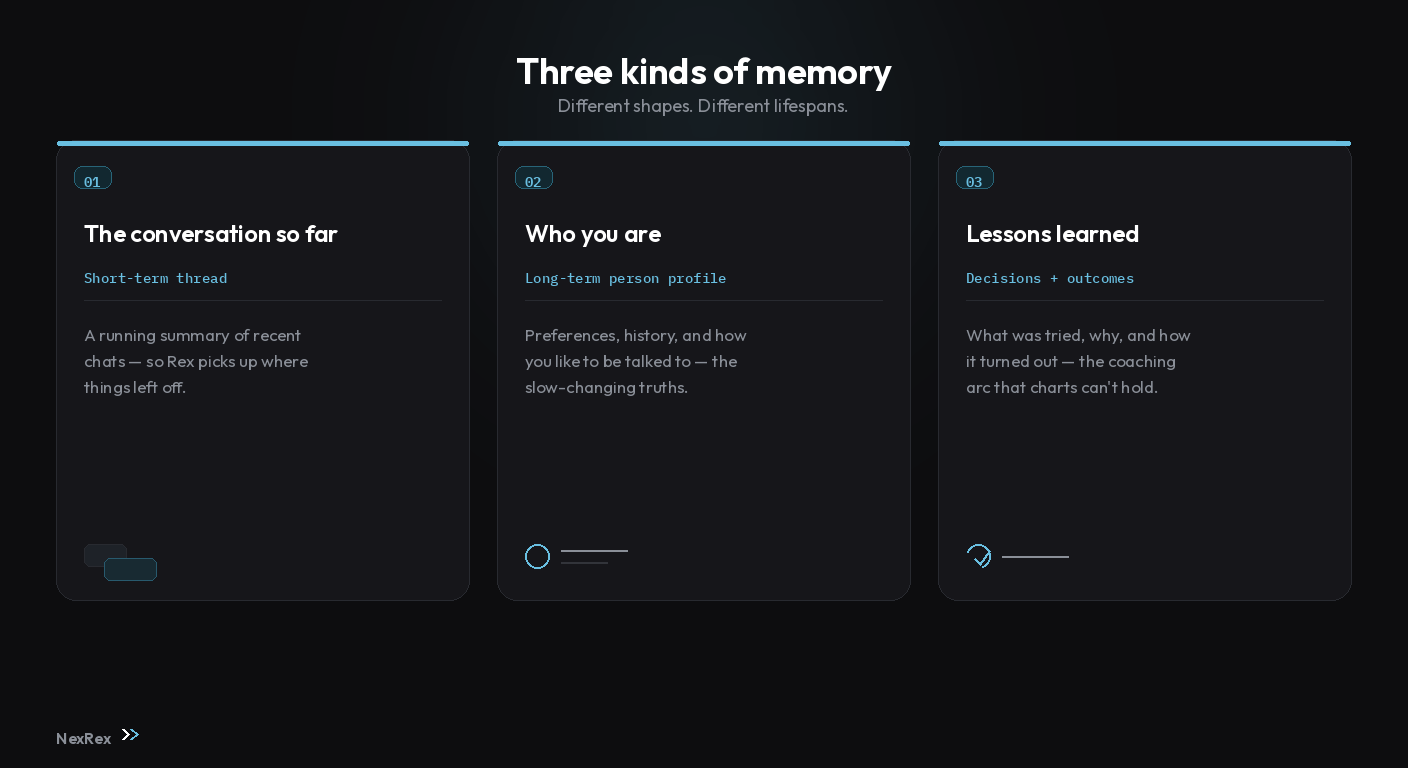
"Memory" sounds like one thing. In practice the things worth remembering have different shapes and lifespans, so Rex keeps three kinds.
The conversation so far. The short-term thread — a running summary of recent chats. It lets Rex pick up where things left off instead of asking you (or your coach) to re-establish context every time. It's allowed to drift and fade; it's about this stretch of conversations, not forever.
Who you are. The long-term picture of you as a runner and a person: that you prefer morning runs, that you're training for a spring marathon to manage stress as much as to hit a time, that you tend to report pace a little faster than your watch recorded. These are the slow-changing truths that should still be true next month.
Here's the deliberate design choice: Rex remembers the person, not the numbers.
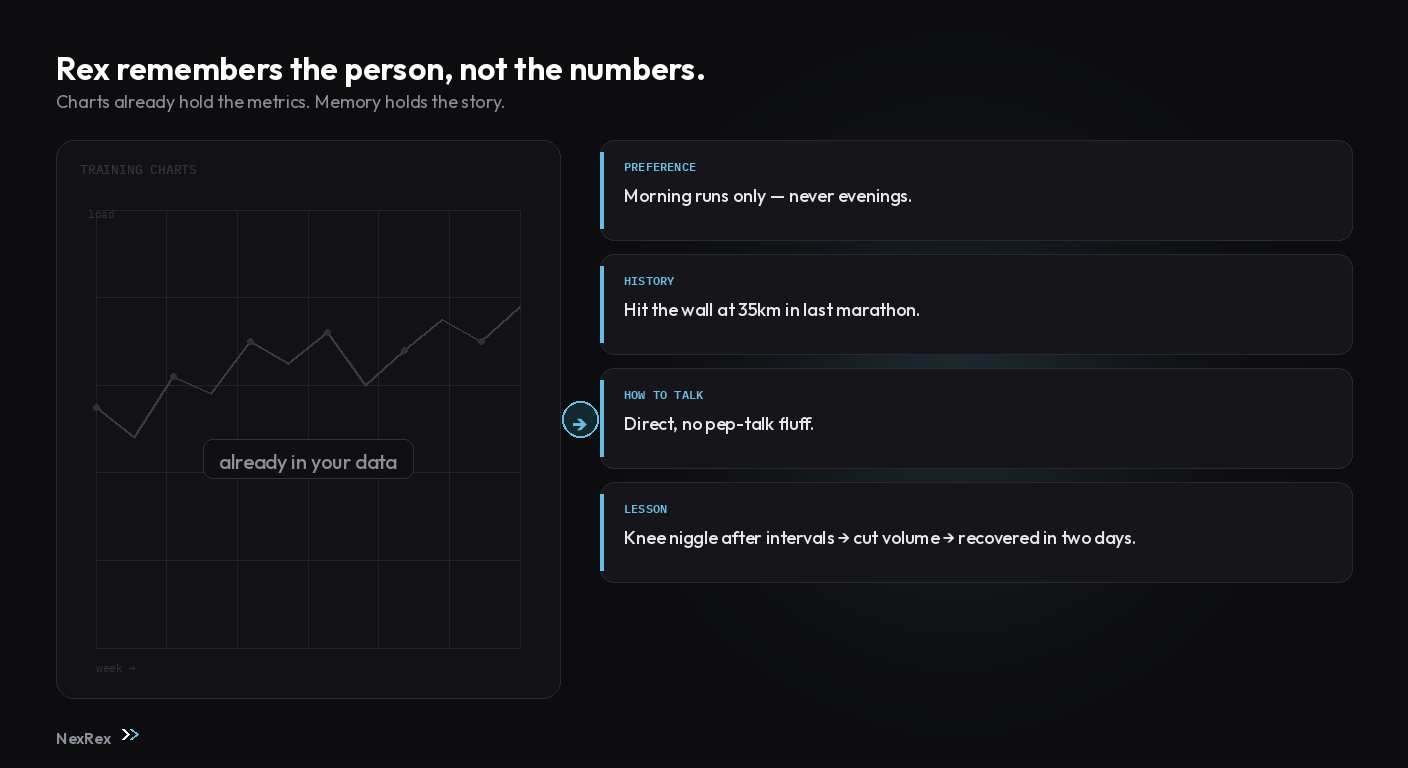
Your training load, weekly mileage, and resting heart rate already live in your charts, kept accurate and up to date. There's no point keeping a second, worse, out-of-date copy. Memory holds what the charts can't: preferences, history, lived experiences, and how you like to be talked to. "Hit the wall at 35km in my last marathon" is a story worth keeping. "Ran 9km on Tuesday" already has a home in the data.
Lessons learned. The coaching memory — decisions and how they turned out. Not "we chatted about knee pain," but the arc: knee pain after interval sessions → cut volume and added cross-training → recovered in two days. The hard-to-replace part is the why behind a change. Training history can show the plan got lighter; only this kind of memory knows it got lighter because a niggle looked like the start of an overuse pattern. When a coach makes that call, Rex keeps the reasoning — and once the outcome is known, that lesson stays for the long haul.
Most conversations don't produce a lesson, and that's intentional. Answering a question or reading back your week isn't a coaching decision. Rex only files a lesson when the answer is yes: will this athlete train, recover, or race differently because of it?
More than what you say
A lot of useful context comes from data nobody types — the stream from your watch and your training.
NexRex turns that raw stream — heart rate, heart-rate variability (HRV), sleep, training load — into plain-language signals. A drop in overnight HRV, an elevated resting heart rate, a spike in load, a run of poor sleep: each becomes a readable flag like "recovery is low today" rather than a chart someone has to interpret alone.
On top of those signals, Rex keeps a simple read of where an athlete is right now — coming back from a break, deep in a block, plateauing, in race week, recovering after a goal race. That sense of stage shapes tone and substance. And one rule sits above the others: anything that looks like an injury comes first. Safety outranks ambition. Rex flags it; the coach decides what to do.
What the memory powers
Memory and signals aren't the product. What they enable is.
A conversation that doesn't restart from zero. Because Rex loads who you are, the thread so far, and relevant lessons before it answers, every chat builds on the last one. You ask "should I jog or walk the recovery?" and Rex already has your knee history, your morning-only schedule, and how a similar call played out — context it can hand to your coach, or use to keep you company if you're solo.
A daily insight — what Rex noticed. Each day, Rex reads the latest signals against goals and history and writes a short, human read of where things stand. Not a wall of metrics — a sentence or two pointing at what matters today. For a coach, that's a fast pulse on every athlete; for a solo runner, a nudge in the right direction.
A weekly summary you'll actually read. Once a week, Rex pulls training together — distance, pace, how the week tracked against the plan, how recovery held up — into a short narrative. Athletes get their own. Coaches get a roster-level view, and Rex can hand a coach a draft to review before it goes out — keeping the human in the loop rather than replacing them.
For coaches: a partner, not a replacement
If you're a coach, this is the heart of it. Rex isn't there to coach for you; it's there to carry the parts that don't fit in one person's head.
Rex runs on one memory per athlete, shared between you and them. When you note something — "watch the left calf, it's been tight" — that observation stays with that athlete and shapes context even when you're not in the conversation. Lessons learned keep your decisions and outcomes consistent. Weekly summaries arrive as drafts you approve, not automatic messages under your name without a look.
The property that makes this safe is continuity without leakage. Rex surfaces the right athlete's context at the right moment — and never lets one athlete's facts cross into another's.
This is why Rex is at its best with a coach and a running group: the memory becomes leverage for the human doing the real coaching, across more athletes than anyone could track by hand.
Running solo? Rex still remembers
Not everyone has a coach, and Rex doesn't require one. On your own, it's a companion that carries the same memory — preferences, history, lessons from what you've tried — so conversations build on each other and your weekly summary reflects you. Continuity and a second set of eyes on recovery data, without anyone else in the loop.
Memory that sleeps
Left alone, memory grows endlessly and goes stale. Once a week, Rex does quiet housekeeping: checks whether that knee thing resolved and records the outcome, merges duplicate notes, distills repeated patterns into the durable profile, and lets go of what's no longer true — while keeping, indefinitely, coaching decisions whose outcomes it knows.
Raw interactions land fast and a little messy during the week. The weekly pass is where they become durable and clean.
Built as a pipeline
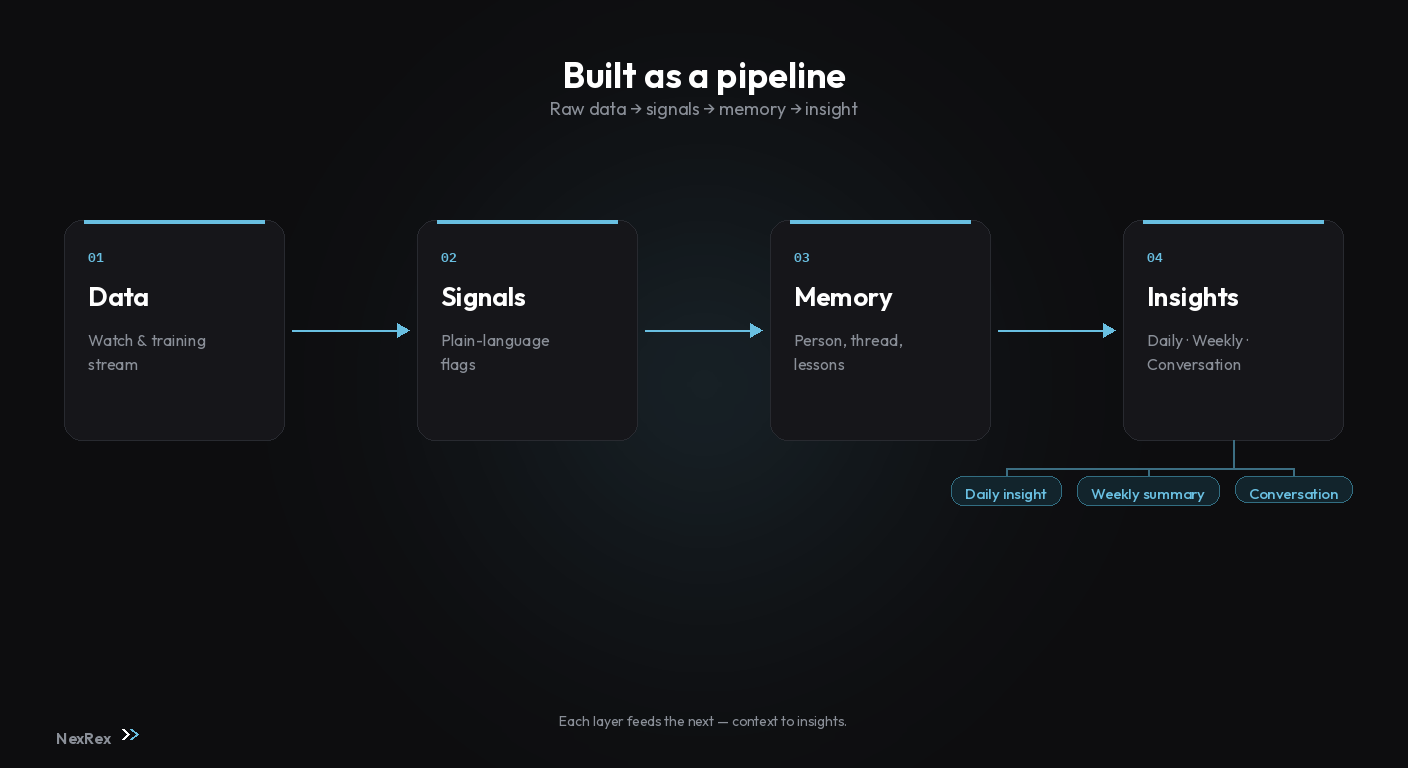
None of this is a single clever trick. It's a deliberate pipeline: raw data becomes readable signals, signals and conversation become memory, memory becomes a daily insight, a weekly summary, and a conversation that knows you. Each layer feeds the next.
That's the idea behind Rex: not a replacement for your coach, but the AI assistant that makes coaching personal at scale — and a companion that remembers you even when you're running alone.
Want to see Rex with your own athletes? Start a Coach trial or read how to connect NexRex to Grok Bot for real training context in your AI assistant.